Solutions

Company

Resources

Blog

Contact

Login

    • Assurance

      Smart Contract Assessment

      Securing code integrity, protecting digital assets

      Blockchain Layer 1 Assessment

      Assessing protocols, securing blockchain foundations

      Code Security Audit

      Uncovering flaws, strengthening software integrity

      Web Application Penetration Testing

      Exposing weaknesses, fortifying digital defenses

      Cloud Infrastructure Penetration Testing

      Securing configurations, protecting critical environments

      Red Team Exercise

      Simulating real-world attacks, strengthening defenses

      AI Red Teaming

      Testing AI systems against real threats

      AI Security Assessment

      Securing AI models, data, and pipelines

    • Advisory

      AI Advisory

      Guiding secure, strategic AI adoption forward

      Risk Assessment

      From unknown threats to actionable insights

      Blockchain Architecture Assessment

      Optimizing architecture for tomorrow’s networks

      Compliance Readiness

      Stay ready as regulations evolve

      Custody and Key Management Assessment

      Securing the heart of digital custody

      Technical Due Diligence

      See the risks before you invest

      Technical Training

      Empower your teams to secure what matters

    • Who We Are

      The best security engineers in the world

      Careers

      Work with the elite

      Who Trusts Us

      The trusted security advisor for blockchain and financial services industries

      Brand

      Access official logos, fonts, and guidelines

      Service Commitments

      Committed to Protecting Your Data

    • Audits

      In-depth evaluations of smart contracts and blockchain infrastructures

      BVSS

      Blockchain Vulnerability Scoring System

      Disclosures

      All the latest vulnerabilities discovered by Halborn

      Case Studies

      How Halborn’s solutions have empowered clients to overcome security issues

      Reports

      Comprehensive reports and data

  • Blog

  • Contact

  • Login

STAY CURRENT WITH HALBORN

Subscribe to the monthly Halborn Digest for our top blogs and videos, major company announcements, new whitepapers, webinar and event invites, and one exclusive interview.

ADVISORY SERVICES

AI AdvisoryRisk AssessmentBlockchain Architecture AssessmentCompliance ReadinessCustody and Key Management AssessmentTechnical Due DiligenceTechnical Training

ASSURANCE SERVICES

AI Security AssessmentAI Red TeamingSmart Contract AssessmentBlockchain Layer 1 AssessmentCode Security AuditWeb Application Penetration TestingCloud Infrastructure Penetration TestingRed Team Exercise

COMPANY

Who We AreWho Trusts UsService CommitmentsCareersBrandBlogContact

RESOURCES

AuditsDisclosuresReportsBVSSCase Studies
Halborn Logo
Privacy PolicyTerms of UseVulnerability Disclosure Policy

© Halborn 2026. All rights reserved.

Smart Contract Assessment

Securing code integrity, protecting digital assets

Blockchain Layer 1 Assessment

Assessing protocols, securing blockchain foundations

Code Security Audit

Uncovering flaws, strengthening software integrity

Web Application Penetration Testing

Exposing weaknesses, fortifying digital defenses

Cloud Infrastructure Penetration Testing

Securing configurations, protecting critical environments

Red Team Exercise

Simulating real-world attacks, strengthening defenses

AI Red Teaming

Testing AI systems against real threats

AI Security Assessment

Securing AI models, data, and pipelines

AI Advisory

Guiding secure, strategic AI adoption forward

Risk Assessment

From unknown threats to actionable insights

Blockchain Architecture Assessment

Optimizing architecture for tomorrow’s networks

Compliance Readiness

Stay ready as regulations evolve

Custody and Key Management Assessment

Securing the heart of digital custody

Technical Due Diligence

See the risks before you invest

Technical Training

Empower your teams to secure what matters

Who We Are

The best security engineers in the world

Careers

Work with the elite

Who Trusts Us

The trusted security advisor for blockchain and financial services industries

Brand

Access official logos, fonts, and guidelines

Service Commitments

Committed to Protecting Your Data

Audits

In-depth evaluations of smart contracts and blockchain infrastructures

BVSS

Blockchain Vulnerability Scoring System

Disclosures

All the latest vulnerabilities discovered by Halborn

Case Studies

How Halborn’s solutions have empowered clients to overcome security issues

Reports

Comprehensive reports and data

THIS WEBSITE USES COOKIES

We use cookies to personalise content and ads, to provide social media features and to analyse our traffic. We also share information about your use of our site with our social media, advertising and analytics partners who may combine it with other information that you've provided to them or that they've collected from your use of their services. You consent to our cookies if you continue to use our website. Learn More.

ChatGPT vulnerability detection report

Discover whether ChatGPT is able to detect vulnerabilities across smart contracts and solve CTF challenges
Download the full report now.

Halborn logotext
ChatGPT Report Hero
ChatGPT Report Hero
Can ChatGPT detect Smart Contract vulnerabilities?

In July 2023, we evaluated ChatGPT's smart contract vulnerability detection capabilities by testing 134 examples of vulnerable smart contracts (compiled in this GitHub repo) that were known to contain exploitable vulnerabilities and breaking them up into 41 groups based on the types of vulnerabilities that they contained. We then fed the smart contracts into ChatGPT and prompted it to find the vulnerabilities*.

Halborn H

/ How well did ChatGPT perform? Keep scrolling to find out! /

Where Does ChatGPT excel?

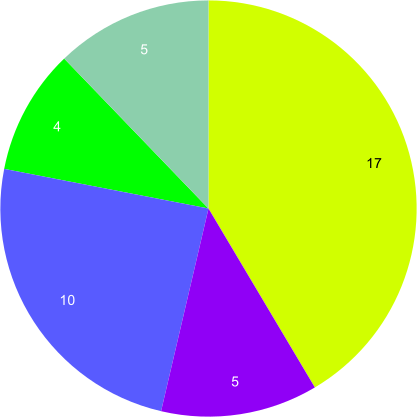
ChatGPT always successfully identified the following types of smart contract vulnerabilities:
  • Bad randomness
  • Use of deprecated functions
  • Right-to-left override control character
  • Integer overflow
  • Missing protection against signature replay
  • Typographical error
  • Variable shadowing
  • Arbitrary jump with function type variable
  • Logical error
  • Authorization through tx.origin
  • Presence of unused variables
  • Block values as a proxy for time
  • Default visibility
  • Asserting EOA from code side
  • Numerical Precision/Floating points
  • Outdated compiler versions
  • Message call with hardcoded gas amount

NO. of vulnerabilities in range of accuracy

NO. of vulnerabilities in range of accuracy
100%
Between 75% and 99%
Between 50% and 75%
Between 25% and 49%
Between 0% and 24%

Impressive? Not Really...

In most of these cases, the presence of the vulnerability could have been easily identified by looking for certain functions or code patterns. For example, simply scanning code for the use of tx.origin or a pragma version would identify certain types of vulnerabilities. In general, ChatGPT detection ratio is around 75% with all types of vulnerabilities and in all tested smart contracts. However, we have discovered that ChatGPT can better identify vulnerabilities when prompted if a code sample contained a specific vulnerability (e.g., reentrancy) compared to asking it to find all vulnerabilities in a piece of code.

In fact, the specific vulnerability prompt increased ChatGPT-4's detection accuracy from 76.1% to 86.6%!

Where ChatGPT Falls Short

while ChatGPT is very effective at finding certain types of vulnerabilities, it struggles with the understanding of how Solidity or how EVM works.

In general, there are certain types of smart contract vulnerabilities that ChatGPT struggles with finding, regardless of the ChatGPT version tested:

[object Object]

Abuse of
Global Semantic

[object Object]

Insufficient
Gas Griefing

[object Object]

Storage
Collisions

[object Object]

Hash collisions with multiple variable length arguments

[object Object]

Reference to an external malicious contract

Furthermore, different versions of ChatGPT struggle with different vulnerabilities.

ChatGPT-3.5 struggled to identify:

  • Forced reception of Ether
  • Unencrypted private data on-chain
  • Short address attacks

ChatGPT-4 struggled to identify:

  • Delegated call to an untrusted callee
  • Signature malleability
  • Write to arbitrary storage location
Code Review

ChatGPT was able to identify certain vulnerabilities with 100% accuracy — such as variable shadowing or bad randomness— within smart contracts. However, it tends to struggle with different variations of these attacks. For example, most instances of read-only and cross-function reentrancy were not detected during the study. Similarly, ChatGPT overlooked DoS by external calls without gas stipends in 2 out of 3 prompts.

ChatGPT can assess a lot of vulnerabilities.
Can you predict how ChatGPT did?

Can ChatGPT solve CTFs?

What is CTF?

CTF, or Capture The Flag, is a type of cybersecurity exercise where participants engage in solving security-related challenges, simulating real-world scenarios to enhance their skills and knowledge in protecting systems against cyber threats.

In our study, we found that ChatGPT could completely
solve CTF challenges 43.3% of the time

ChatGPT also offered a partial solution in an additional 20% of cases.

These results depend largely on the complexity of the CTF, with more complex challenges having lower success rates
Ethernaut

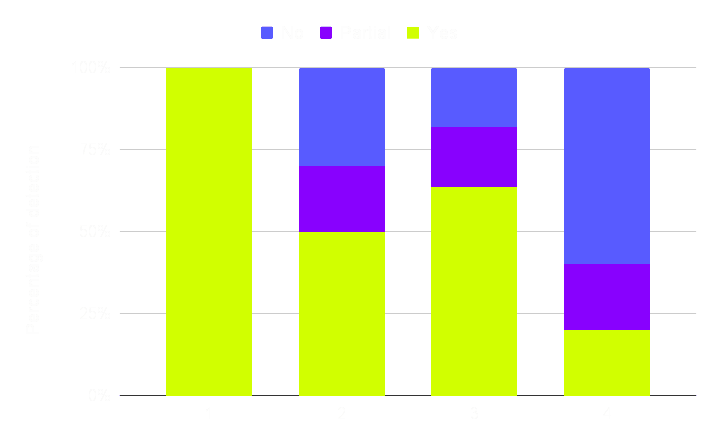
  • In Ethernaut, ChatGPT was able to solve most of the challenges excelling in the first level with 100% accuracy. Although it was clear that with increasing difficulty, it started to struggle more. 
  • With a difficulty level of 4, it’s effectiveness decreased to 25%:
Ethernaut

Capture The Ether

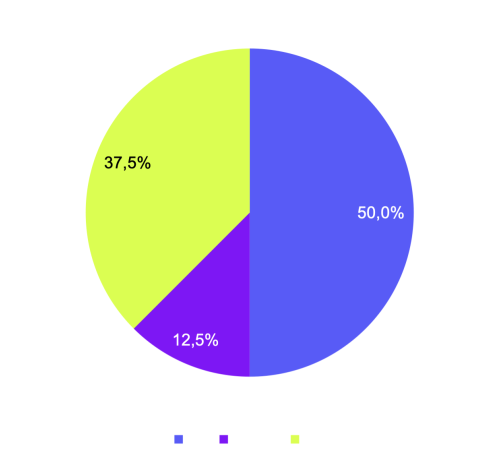
  • In Capture the Ether, we can observe that ChatGPT is only able to solve correctly 37.5% of the challenges versus 55% in Ethernaut:
Capture The Ether

Damn Vulnerable DeFi

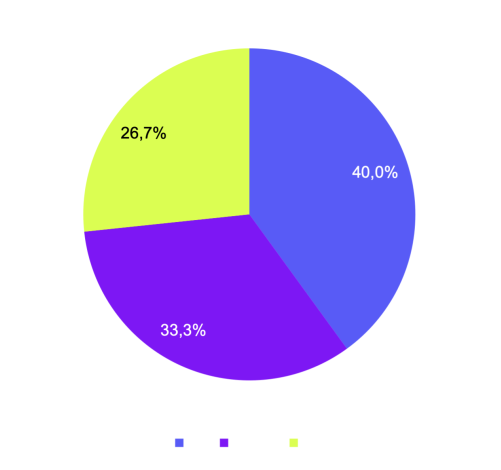
  • This percentage drops even further for Damn Vulnerable Defi’s CTFs, falling to 26.7%. These challenges are often more complex because they typically require an analysis of multiple contracts and how they interact with each other.
  • This is different from previous repositories, where challenges usually center on just one contract.
Damn Vulnerable DeFi

Also, ChatGPT has much higher success rates if the CTF and its solution were published before ChatGPT was trained and, therefore,
were part of the tools’ training data set.

Top 3 Tips for Using ChatGPT to Detect Smart Contract Vulnerabilities:

  • Number

    Because ChatGPT was using data from 2021 and prior, ChatGPT cannot be used to identify ALL issues within a smart contract.
    Organizations should always work with security experts like Halborn to supplement and enhance their protection.

  • Number

    Run multiple versions of ChatGPT when analyzing a smart contract to improve the probability of detection.

  • Number

    Be specific with your prompts: ask ChatGPT if a code sample contains a specific vulnerability (e.g., reentrancy). This not only increases the accuracy of its findings, it also speeds up the process of identifying a vulnerability in the code .

Want to stay ahead?

Sign up to receive future reports from our research team

Need Help? We've got your back!

Don't let your platform fall victim to smart contract vulnerabilities or other security threats. Contact Halborn now for professional security advisory and auditing services.


Data SeaData Sea