




























Summary
100% of all REPORTED Findings have been addressed
- 0Risk Accepted
- 10Acknowledged
- 2Solved
- 12All Findings
- Critical0
- High0
- Medium1
- 1Solved
- Low1
- 1Solved
- Informational10
- 10Ack.
Introduction#
FortunaFi engaged Halborn to conduct a security assessment on their smart contracts beginning on March 31st, 2025 and ending on April 2nd, 2025. The security assessment was scoped to the smart contracts provided to Halborn. Commit hashes and further details can be found in the Scope section of this report.
The FortunaFi codebase in scope consists of smart contracts responsible for token migration functionality, liquidity rebalancing mechanisms, and an interest-bearing savings token implementation based on the ERC4626 standard.
Assessment Summary#
Halborn was provided 3 days for the engagement and assigned 1 full-time security engineer to review the security of the smart contracts in scope. The engineer is a blockchain and smart contract security expert with advanced penetration testing and smart contract hacking skills, and deep knowledge of multiple blockchain protocols.
The purpose of the assessment is to:
Identify potential security issues within the smart contracts.
Ensure that smart contract functionality operates as intended.
In summary, Halborn identified some improvements to reduce the likelihood and impact of risks, which were partially addressed by the FortunaFi team. The main ones were the following:
Apply the scaling factor consistently to the shortfall_ value in the _maxRebalance() function.Consider adding a whitelist of trusted adapters and verifying that the provided adapter is whitelisted on calls to the rebalance() function.Implement OpenZeppelin's SafeERC20 library to wrap all ERC20 token interactions.
Test Approach and Methodology#
Halborn performed a combination of manual review of the code and automated security testing to balance efficiency, timeliness, practicality, and accuracy in regard to the scope of this assessment. While manual testing is recommended to uncover flaws in logic, process, and implementation; automated testing techniques help enhance coverage of smart contracts and can quickly identify items that do not follow security best practices.
The following phases and associated tools were used throughout the term of the assessment:
Research into architecture, purpose and use of the platform.
Smart contract manual code review and walkthrough to identify any logic issue.
Thorough assessment of safety and usage of critical Solidity variables and functions in scope that could led to arithmetic related vulnerabilities.
Local testing with custom scripts (
Foundry).Fork testing against main networks (
Foundry).Static analysis of security for scoped contract, and imported functions (
Slither).
Static Analysis Report#
Description#
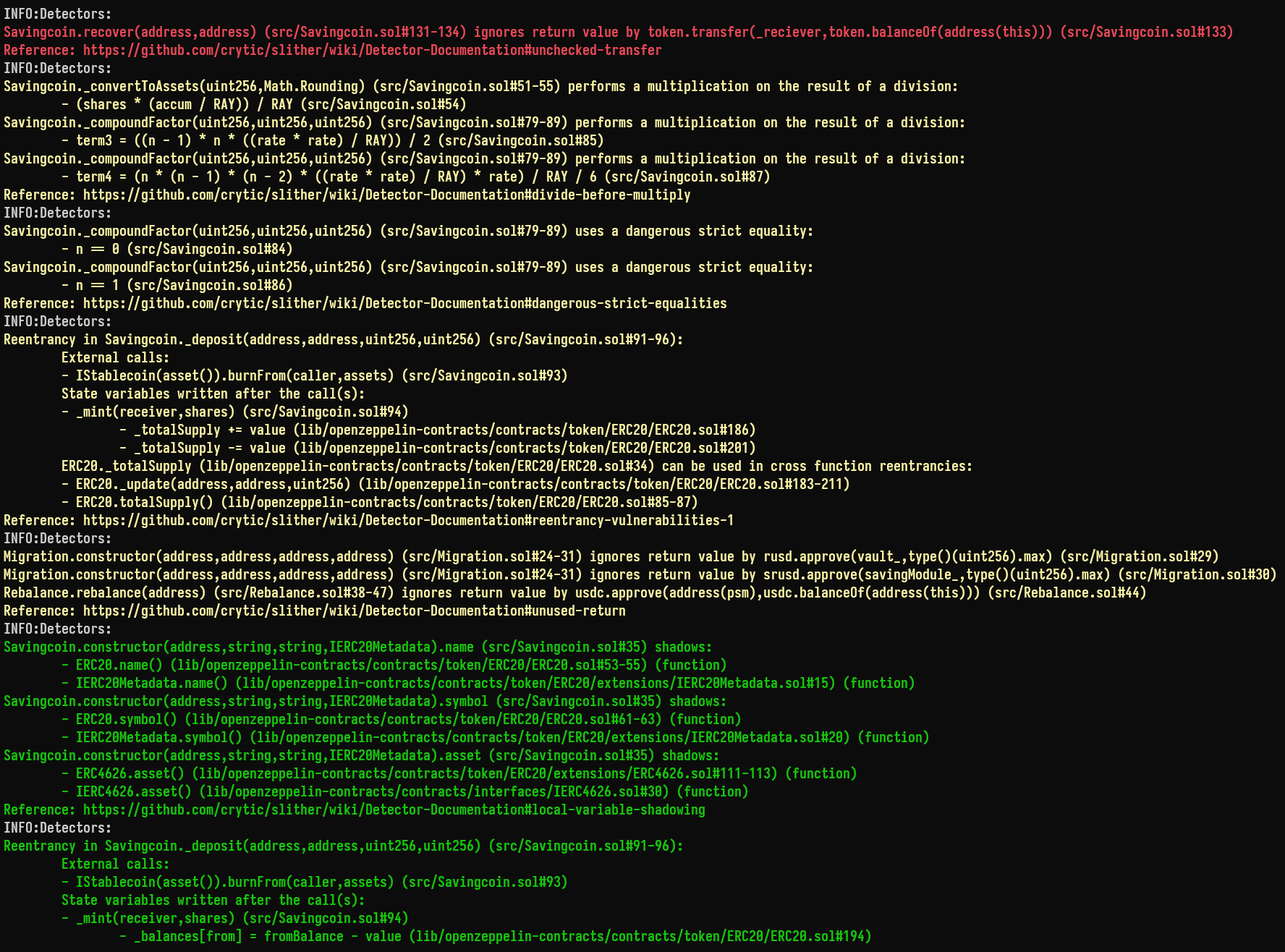
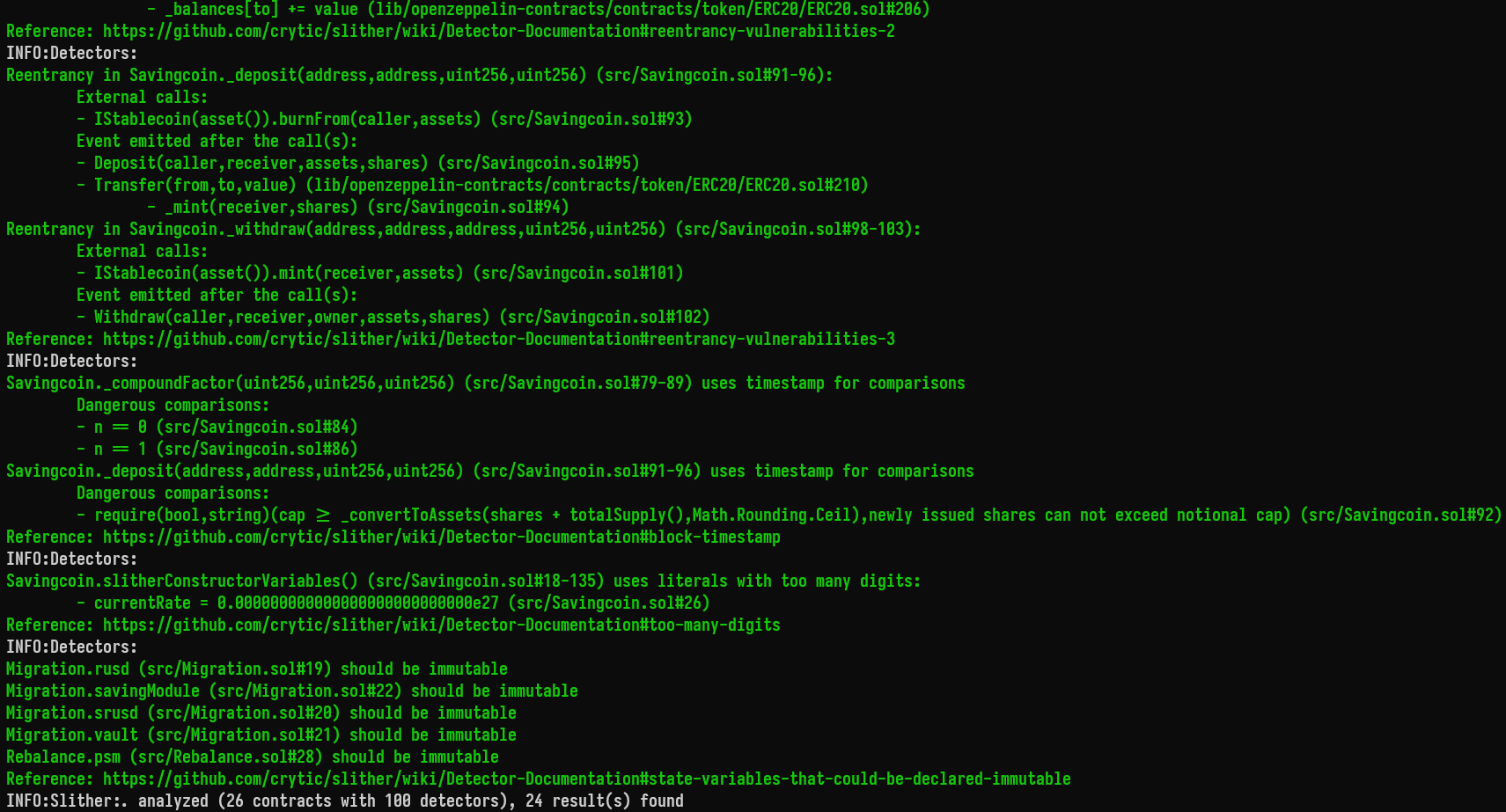
Halborn used automated testing techniques to enhance the coverage of certain areas of the smart contracts in scope. Among the tools used was Slither, a Solidity static analysis framework. After Halborn verified the smart contracts in the repository and was able to compile them correctly into their abis and binary format, Slither was run against the contracts. This tool can statically verify mathematical relationships between Solidity variables to detect invalid or inconsistent usage of the contracts' APIs across the entire code-base.
The security team assessed all findings identified by the Slither software, however, findings with related to external dependencies are not included in the below results for the sake of report readability.
Output#
The findings obtained as a result of the Slither scan were reviewed, and many were not included in the report because they were determined as false positives.
Risk Methodology#
5.1 EXPLOITABILITY
Attack Origin (AO):
Attack Cost (AC):
Attack Complexity (AX):
Metrics:
| EXPLOITABILITY METRIC () | METRIC VALUE | NUMERICAL VALUE |
|---|---|---|
| Attack Origin (AO) | Arbitrary (AO:A) | 1 |
| Specific (AO:S) | 0.2 | |
| Attack Cost (AC) | Low (AC:L) | 1 |
| Medium (AC:M) | 0.67 | |
| High (AC:H) | 0.33 | |
| Attack Complexity (AX) | Low (AX:L) | 1 |
| Medium (AX:M) | 0.67 | |
| High (AX:H) | 0.33 |
5.2 IMPACT
Confidentiality (C):
Integrity (I):
Availability (A):
Deposit (D):
Yield (Y):
Metrics:
| IMPACT METRIC () | METRIC VALUE | NUMERICAL VALUE |
|---|---|---|
| Confidentiality (C) | None (C:N) | 0 |
| Low (C:L) | 0.25 | |
| Medium (C:M) | 0.5 | |
| High (C:H) | 0.75 | |
| Critical (C:C) | 1 | |
| Integrity (I) | None (I:N) | 0 |
| Low (I:L) | 0.25 | |
| Medium (I:M) | 0.5 | |
| High (I:H) | 0.75 | |
| Critical (I:C) | 1 | |
| Availability (A) | None (A:N) | 0 |
| Low (A:L) | 0.25 | |
| Medium (A:M) | 0.5 | |
| High (A:H) | 0.75 | |
| Critical (A:C) | 1 | |
| Deposit (D) | None (D:N) | 0 |
| Low (D:L) | 0.25 | |
| Medium (D:M) | 0.5 | |
| High (D:H) | 0.75 | |
| Critical (D:C) | 1 | |
| Yield (Y) | None (Y:N) | 0 |
| Low (Y:L) | 0.25 | |
| Medium (Y:M) | 0.5 | |
| High (Y:H) | 0.75 | |
| Critical (Y:C) | 1 |
5.3 SEVERITY COEFFICIENT
Reversibility (R):
Scope (S):
Metrics:
| SEVERITY COEFFICIENT () | COEFFICIENT VALUE | NUMERICAL VALUE |
|---|---|---|
| Reversibility () | None (R:N) | 1 |
| Partial (R:P) | 0.5 | |
| Full (R:F) | 0.25 | |
| Scope () | Changed (S:C) | 1.25 |
| Unchanged (S:U) | 1 |
| Critical | High | Medium | Low | Informational |
| 9 - 10 | 7 - 8.9 | 4.5 - 6.9 | 2 - 4.4 | 0 - 1.9 |
Scope#
Assessment Summary & Findings Overview#
# | Title | Severity | Score | Status |
|---|---|---|---|---|
| Inconsistent decimal scaling in rebalance comparison | Medium | 6.3 | Solved03/31/2025 | |
| Permissionless rebalance function accepts untrusted adapters | Low | 2.5 | Solved04/04/2025 | |
| Unsafe ERC20 token transfer methods | Informational | 0.8 | Acknowledged04/07/2025 | |
| Missing events | Informational | 0.3 | Acknowledged04/07/2025 | |
| Missing input validation | Informational | 0.3 | Acknowledged04/07/2025 | |
| Floating pragma | Informational | 0.3 | Acknowledged04/07/2025 | |
| Unchanged state variables can be marked as immutable | Informational | 0.2 | Acknowledged04/07/2025 | |
| Use of magic numbers | Informational | 0.1 | Acknowledged04/07/2025 | |
| Typo | Informational | 0.0 | Acknowledged04/07/2025 | |
| Use of revert strings instead of custom errors | Informational | 0.0 | Acknowledged04/07/2025 | |
| APY function returns compound factor instead of percentage yield | Informational | 0.0 | Acknowledged04/07/2025 | |
| Missing pausing/unpausing mechanism | Informational | 0.0 | Acknowledged04/07/2025 |
Findings & Tech Details#
Description
Recommendation
Description
Recommendation
Description
Recommendation
References
Remediation Comment
Description
Recommendation
References
Remediation Comment
Description
Recommendation
References
Remediation Comment
Description
Recommendation
References
Remediation Comment
Description
Recommendation
References
Remediation Comment
Description
Recommendation
References
Remediation Comment
Description
Recommendation
Remediation Comment
Description
Recommendation
References
Remediation Comment
Description
Recommendation
Remediation Comment
Description
Recommendation
Remediation Comment
Disclaimer#
Halborn strongly recommends conducting a follow-up assessment of the project either within six months or immediately following any material changes to the codebase, whichever comes first. This approach is crucial for maintaining the project’s integrity and addressing potential vulnerabilities introduced by code modifications.